Discover Scuba Diving: How to Dive in Puerto Rico Without Getting Certified
One of the most persistent myths in adventure travel is that you need weeks of classes, technical exams, and a permanent license just to take your first breath underwater.
You do not.
If you are traveling to Puerto Rico and want to explore vibrant coral reefs, swim alongside sea turtles, and experience the weightless freedom of the ocean, you can do it this week through a program called Discover Scuba Diving.
Designed by international training agencies like PADI, this introductory experience is not a full certification course. Instead, it is a closely supervised, single-day gateway that takes you from complete beginner to real ocean diver in just a few hours.
Here is an insider’s breakdown of how the program works, what you will actually do, safety parameters, and how to get the most out of your first Caribbean dive.
What Exactly Is Discover Scuba Diving?
Discover Scuba Diving—often referred to in the industry as a DSD, an intro dive, or a resort dive—is a structured, non-certification experience.
Think of it like tandem skydiving: you receive a thorough briefing on equipment and safety protocols, practice the core mechanical skills under direct observation, and then head out to explore the underwater world strapped into standard scuba gear with a professional dive instructor right by your side.
You do not receive a lifetime certification card at the end of the day. What you do get is an authentic, gear-on, open-water Caribbean dive down to a safe, controlled depth, with zero homework required beforehand.
How the Day Breaks Down: Step by Step
A reputable operator will never push you straight off a boat into deep water. The experience is engineered in three distinct phases designed to build comfort and confidence systematically.
1. The Dry Briefing (30–45 Minutes)
Your morning starts on land. Your instructor will introduce you to your life-support system: the buoyancy control device (BCD), the regulator you breathe through, the submersible pressure gauge, your mask, and your fins.
You will cover the golden rules of scuba diving:
- Never hold your breath: You breathe continuously, slowly, and deeply.
- Equalization: How to gently pop your ears as you descend to match water pressure.
- Hand signals: Essential underwater communication for “OK,” “Going up,” “Problem,” and air checks.
2. Confined Water Practice (45–60 Minutes)
Before you explore open reefs, you step into calm, shallow water—either a dedicated training pool or a protected, pool-like ocean cove with a sandy bottom where you can stand up at any moment.
Here, your instructor will have you practice three essential safety skills:
- Breathing underwater while stationary to adapt to the sensation.
- Clearing water out of your regulator and recovering your mouthpiece if it slips out.
- Clearing water from your mask without surfacing.
Once you prove you can perform these actions calmly, your instructor will guide you into a horizontal swimming posture and help you dial in your buoyancy.
3. The Open Water Reef Tour (45–60 Minutes)
Once you are relaxed and confident, the real dive begins. Accompanied by your instructor—who maintains strict, small-group ratios of no more than two to four beginners per professional—you will descend onto a living Caribbean reef.
The maximum allowable depth for a first-time Discover Scuba dive is 40 feet (12 meters), though most introductory tours hover comfortably between 20 and 30 feet. This depth zone receives the most abundant sunlight, keeping water warm, colors vivid, and marine life highly active.
What You Will See Beneath the Surface
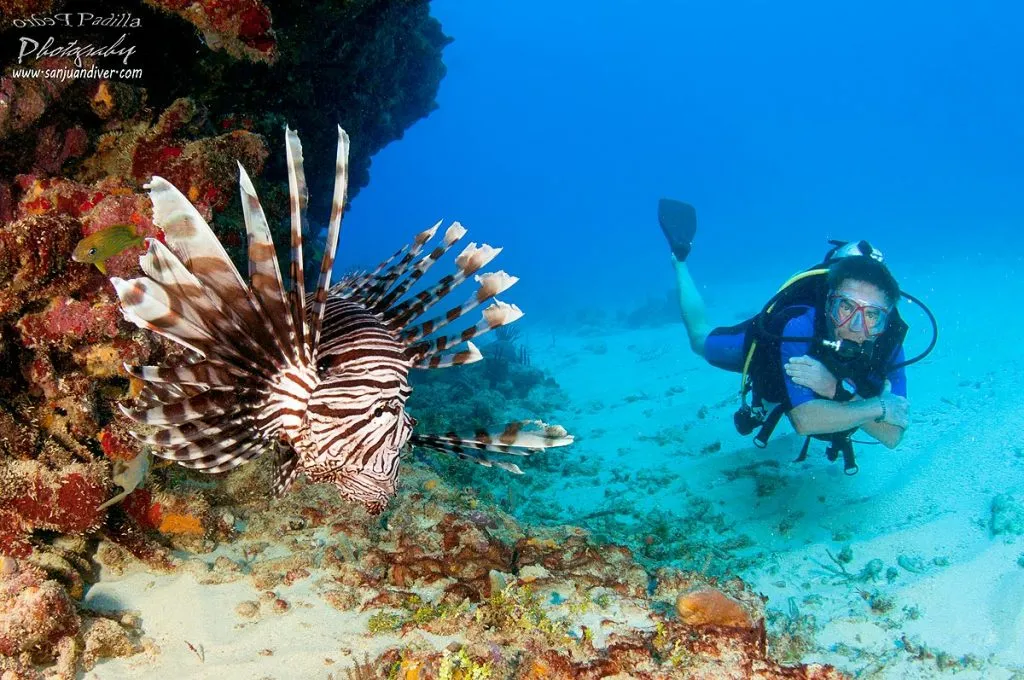
Puerto Rico’s coastal shelves are teeming with tropical marine life that thrives in shallow, sunlit waters. During a typical introductory dive, you can expect to encounter:
- Sea Turtles: Both hawksbill and green sea turtles are common visitors to nearshore reefs and seagrass beds, frequently grazing within arm’s reach of divers.
- Reef Fish: Massive schools of blue tangs, vibrant French and queen angelfish, yellowtail snappers, parrotfish crunching on coral, and curious trumpetfish.
- Fascinating Macro Critters: Arrow crabs, spiny lobsters hiding in limestone crevices, and camouflaged octopuses shifting color against the rock.
- Coral Formations: Large brain corals, sea fans swaying with the surge, and delicate pillar corals that create an underwater labyrinth.
Essential Prerequisites and Safety Rules
While you do not need prior dive experience, safety standards require all participants to meet a few non-negotiable baselines:
Physical Comfort in Water
You do not need to be an Olympic swimmer, but you must be comfortable in water over your head. If you panic when your face gets wet, spend an afternoon snorkeling first before booking a scuba tour.
Age Requirements
The minimum age for the Discover Scuba Diving ocean experience is 10 years old.
Medical Questionnaire
Every participant must complete a standard medical questionnaire before entering the water. Conditions such as asthma, cardiovascular issues, epilepsy, recent major surgeries, or chronic sinus and ear blockages may require written clearance from a medical doctor. Be transparent on this form; your safety depends entirely on honest health assessments.
The Critical “No-Fly” Rule
When you breathe compressed air underwater, your body absorbs nitrogen. Because airplanes are pressurized to higher altitudes, flying immediately after diving risks decompression illness. You must wait at least 12 hours after a single introductory dive before boarding an airplane. If you plan to dive on vacation, schedule it early or midway through your trip—never on the morning of your flight home.
What to Look for When Choosing an Operator
Not all introductory dive tours are run with the same level of care. To ensure your first experience is calm, safe, and memorable, evaluate operators using these criteria:
- Strict Instructor Ratios: Ask how many beginners accompany each instructor. Elite shops keep ratios at two to one, or four to one maximum. Never join an operation that herds large crowds of uncertified divers into the water at once.
- Direct Shore vs. Boat Departures: For absolute beginners, shore-entry dives or calm harbor-dock departures eliminate the nausea and disorienting motion of rough open-ocean swells.
- Equipment Condition: Look for well-maintained, modern gear. Clean mouthpieces, clear silicone masks, and functioning depth gauges reflect an operation that invests in guest safety.
- Patience Over Speed: A quality instructor never rushes the shallow-water briefing. If you need ten minutes just floating with your head submerged to get comfortable with the sound of your breathing, your guide should happily grant you that time.
The Next Step: Turning Your First Dive into a License
Most travelers who try Discover Scuba Diving experience an immediate shift in perspective. Floating weightless above a Caribbean reef delivers a sense of silence and adventure that land-based travel simply cannot duplicate.
If you fall in love with the experience, you do not have to start from scratch. Many reputable dive operations will credit your introductory skills and your first open-water dive toward the full, lifetime PADI Open Water Diver certification.
You do not need years of training to see the ocean as it was meant to be seen. You just need a swimsuit, an open mind, and a morning in Puerto Rico’s warm coastal waters.