Wall Diving in Puerto Rico: Exploring the Legendary Drop-Off Along the South Coast
There is a distinct sensation known only to divers who have hovered over a true continental shelf: the sudden transition from emerald shallows to bottomless indigo. Your depth gauge reads sixty feet, but beneath your fins, the earth falls away into two thousand feet of pure liquid space.
This is wall diving along Puerto Rico’s southern coast—a dramatic, largely untouched underwater precipice that rivals the legendary drops of Grand Cayman, Turks and Caicos, or Belize, yet remains one of the best-kept secrets in Caribbean diving.
Stretching over twenty miles along the island’s southern shelf—anchored by the coastal waters of Guánica, Ensenada, and La Parguera—this underwater cliff face offers certified divers pristine coral ecosystems, remarkable horizontal visibility, and an encounter with the Caribbean at its most raw and untamed.
The Architecture of the Edge: Understanding the Southern Shelf
Puerto Rico’s landmass sits near the convergence of tectonic plates. While the island’s northern shore slopes out toward the Atlantic, the southern coast borders the deep Caribbean basin.
Just a few miles offshore from Guánica and Ensenada lies the edge of the insular shelf. Here, the seabed does not gently slope; it fractures into an immediate vertical drop known simply as The Wall.
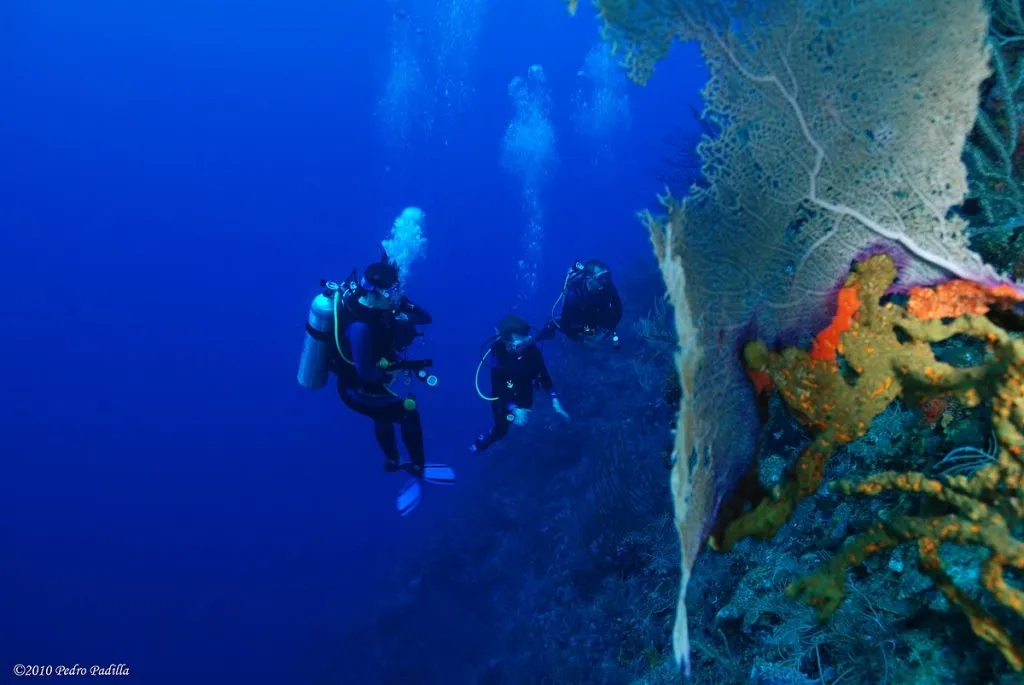
Divers begin their descents over sprawling coral gardens and hard reef terraces sitting comfortably in fifty to sixty feet of water. Within a few fin kicks, the reef reaches its crest—the lip of the abyss. Over the edge, the wall plunges nearly vertically into depths exceeding 1,500 to 2,000 feet.
Because the shelf drops into such deep ocean trenches, water exchange along the wall is driven by clear oceanic currents. This natural circulation keeps the face swept clean of sediment, resulting in visibility that routinely reaches eighty to one hundred feet, with zero runoff from the arid southern hills to cloud the blue.
Signature Drop-Offs: Navigating the Southern Ridge
The southern wall is not a uniform expanse of limestone; it is a dynamic seascape cut through by deep canyons, swim-throughs, buttresses, and vertical chimneys formed over millennia.
Black Wall: The Deep Forest
Named for the weeping black coral trees that cling to its sheer vertical face, this site epitomizes classic deep-wall diving. Dropping past seventy feet, the ambient sunlight softens into cool blues, revealing massive elephant ear sponges, orange rope sponges, and sprawling black coral colonies branching out into the current. Divers who monitor their trim along the face will spot tiny arrow crabs and banded coral shrimp tucked into crevices, while keeping an open eye to the open blue reveals the silhouettes of cruising pelagics.
The Chimney: Natural Caverns and Light Beams
For divers drawn to dynamic geology, The Chimney offers a structural descent like few others in the Caribbean. A vertical fissure opens in the reef crest around fifty feet, allowing divers to drop single-file through a coral-encrusted tunnel before exiting horizontally through the face of the wall into the open Caribbean Sea. Shafts of midday tropical sunlight pierce through overhead crevices, illuminating schools of glassy sweepers and creole wrasse hovering inside the chamber.
Fallen Rock: Dramatic Boulders and Pelagic Crossings
Marked by a colossal section of limestone reef that sheared off the wall ages ago, Fallen Rock creates an underwater amphitheater between the main face and the isolated monolith. The resulting cut acts as a natural channel for ocean currents, attracting larger predatory species. It is one of the most reliable sites along the south coast for close passes by spotted eagle rays, schools of horse-eye jacks, and solitary great barracudas holding station against the flow.
Life on the Precipice: Marine Encounters in the Deep Blue
Diving a vertical wall means managing two distinct marine environments simultaneously: the densely inhabited coral surface of the cliff, and the wild, unpredictable open water behind you.
- Pelagics in the Blue: The proximity to abyssal depths brings pelagic travelers within feet of the reef. Divers regularly share the drop-off with cruising Caribbean reef sharks patrolling their territory, nurse sharks resting along sandy overhangs, and pods of spotted eagle rays banking gracefully along the current lines.
- Corals and Sponges: Because the vertical face receives filtered ambient light rather than harsh overhead sun, it supports delicate deep-water species. Massive barrel sponges—some large enough to hide a diver—grow horizontally outward to maximize filter feeding, alongside vibrant gorgonians and fragile wire corals.
- Reef Inhabitants: Along the top shelf, where sunlight remains abundant, hawksbill sea turtles graze on sponges, green morays weave through brain coral valleys, and schools of yellowtail snappers, French angelfish, and ocean triggerfish surround the safety stop.
Technical Considerations: Mastering Wall Dive Profiles
Wall diving requires a higher level of discipline, spatial awareness, and buoyancy control than shallow reef cruising. With no visible sea floor beneath you, standard visual depth cues disappear.
- Buoyancy and Trim: Perfect neutral buoyancy is mandatory. Descending along a vertical wall can produce a disorienting sensation of floating in mid-air. Divers must rely on their depth gauges and dive computers rather than looking down, ensuring they do not inadvertently drift past their planned maximum depth.
- Gas and Deco Management: Because deep drop-offs tempt divers to push depth limits, keeping a close eye on your pressure gauge and no-decompression limits (NDL) is critical. The optimal profile along the southern shelf starts at your target maximum depth—often between eighty and one hundred feet—and gradually works upward along the wall face, concluding with a relaxed exploration of the shallow coral terrace during safety stops.
- Current Awareness: Southern wall sites experience mild to moderate oceanic currents. Rather than fighting the water, experienced operators run these profiles as gentle drift dives, letting the prevailing Caribbean current carry the group effortlessly along the face while the dive boat tracks bubbles from the surface.
Why the South Coast Remains Puerto Rico’s Premier Frontier
Unlike busy metropolitan dive spots where boats ferry dozens of divers to crowded, heavily trafficked nearshore reefs, southern Puerto Rico offers small-boat intimacy and unspoiled ocean ecosystems.
Here, marinas in Ensenada and Guánica sit minutes away from the drop-off. The atmosphere topside mirrors the quiet majesty below: dry coastal breezes, untouched mangrove bays, and dive charters that run with small, focused groups of passionate divers.
For those who travel with a mask, fins, and a logbook, Puerto Rico’s southern shelf is not just another Caribbean dive. It is an encounter with the true edge of the continent—a place where the earth drops away, the blue deepens, and the ocean reveals its grandest scale.